
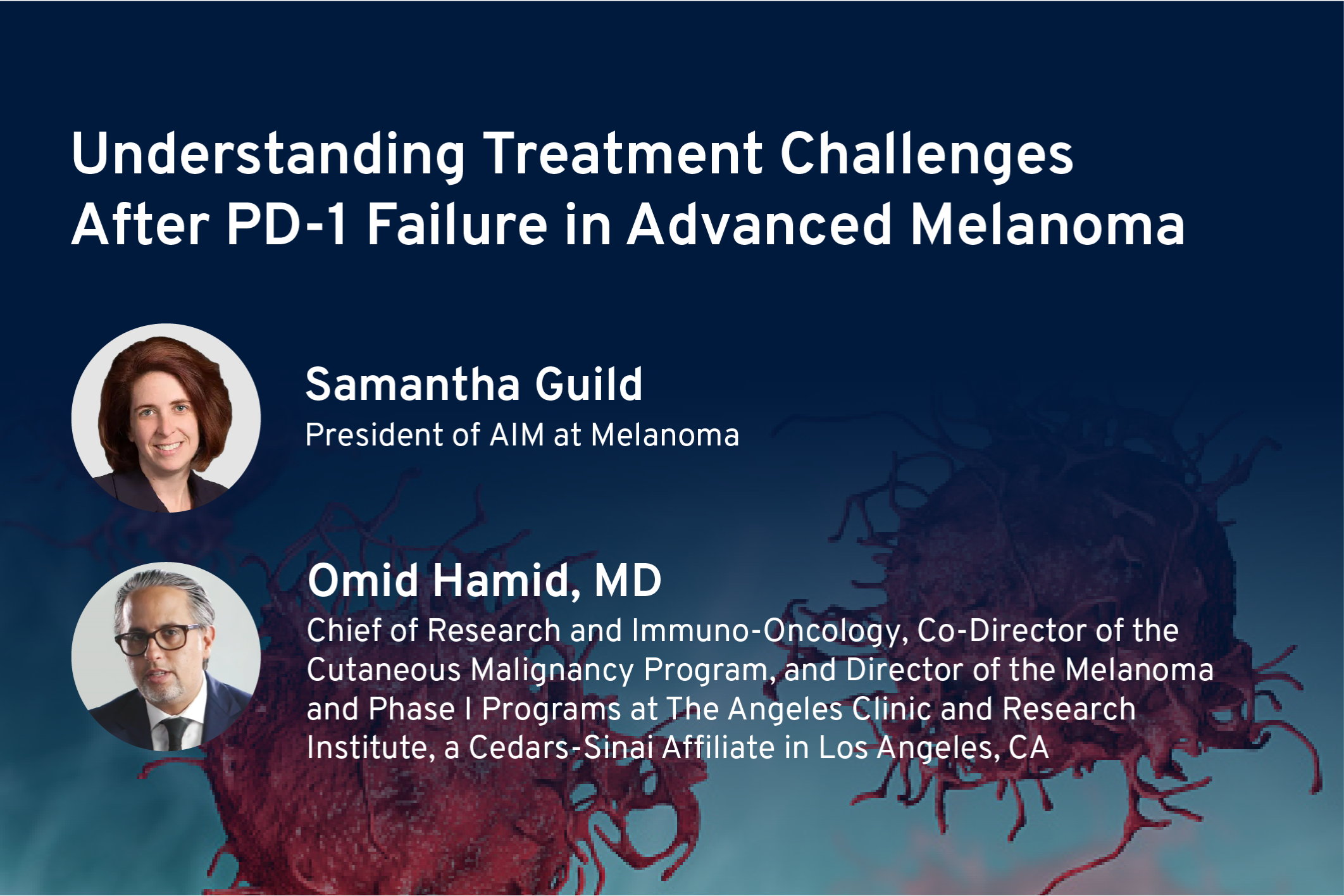
Watch the full video below:
Welcome to the latest installment of Aptitude Health’s interviews on important developments in metastatic melanoma. This segment includes 2 guests
- Samantha (Sam) Guild is the president of AIM at Melanoma, a foundation created in 2004 to direct and fund paradigm-shifting research initiatives, educate patients, health care professionals, and the public, and advocate for survivors and their families. The mission of AIM at Melanoma is to end this disease in our lifetime while improving the lives of those it affects
- Dr Omid Hamid is chief of research and immuno-oncology, co-director of the Cutaneous Malignancy Program, and director of the Melanoma and Phase I Programs at Cedars-Sinai The Angeles Clinic and Research Institute in Los Angeles, CA. He is recognized nationally and internationally as a key opinion leader in immuno-oncologic drug development and melanoma therapeutics
Over the past decade, immune checkpoint inhibitors (eg, anti–PD-1s) have transformed metastatic melanoma treatment, allowing many patients to experience long‑term remission. However, these therapies do not work for everyone. For patients whose melanoma becomes refractory to anti–PD‑1 therapy, approved treatment options remain limited, and many patients do not choose or qualify for them because of toxicity risks (as discussed by Dr Wong in our earlier interview).
In this interview, Dr Hamid and Sam Guild shared complementary clinical and patient-centered perspectives on the challenges of accessing additional treatment after anti–PD-1 therapy fails to control advanced melanoma. Both advocate for starting conversations about treatment options as soon as possible during the course of the disease, given that most patients with advanced melanoma will experience progression during or after initial immune checkpoint inhibitor therapy. In these cases, it is especially important for a melanoma expert, ideally a key opinion leader (KOL), to be part of the health care team, as they have knowledge of the ongoing trials and compassionate use avenues through which patients might access a novel therapeutic option. Among the emerging therapies are oncolytic agents, cellular therapies, and treatments targeting melanoma-specific mutations that might be present, emphasizing the need for all patients to receive molecular biomarker testing. Patients can also explore potential trial options independently through online resources such as clinicaltrials.gov.
However, assessing and accessing options beyond current therapy pathways can be challenging, and clinicaltrials.gov can be cumbersome and intimidating during initial searches. AIM at Melanoma has a physician assistant who can help patients navigate this process and prepare for discussions with their health care team. Both Sam and Dr Hamid see clinical trials as a positive option for the patient, in that they can gain access to a promising new therapy, and for future patients, as their efforts will contribute to the advancement of melanoma therapy. This dedication to clinical research both by clinical investigators and patients is essential for therapeutic advancements to manifest.
It is this belief in the drug development process that motivated Sam’s foundation, AIM at Melanoma, and 5 other patient advocate groups to send a letter to the United States Food and Drug Administration (FDA) earlier this year. This concerned the Biologics License Application (BLA) of an investigational oncolytic virus therapy, RP1 (vusolimogene oderparepvec), which had achieved the primary endpoint in the IGNYTE trial in combination with nivolumab in patients with advanced melanoma after progression on a prior anti–PD-1 therapy. The BLA for RP1 was denied because perceptions at the FDA about whether IGNYTE demonstrated the criteria needed for RP1 to be approved had evolved since the trial’s inception. Together, the patient advocates stated that in addition to the financial considerations of drug developers and clinical research resources devoted to therapy development, patients and their families invest a great deal of time and effort to participate in clinical trials. Changing criteria after the study had already matured was seen as undermining their efforts. Although the BLA for RP1 was not approved during that review round*, Sam and Dr Hamid affirmed that they are committed to helping patients navigate the evolving therapeutic landscape for advanced melanoma, especially when initial immunotherapy fails to control their disease.
The discussion touched on the extraordinary measures clinicians sometimes pursue when all approved therapies are no longer viable. Dr Hamid described single‑patient access pathways, from compassionate use (“expanded access”) programs in the periapproval setting to the relatively rare case of single‑patient Investigational New Drug Applications (INDs), which can allow an appropriate patient to receive an investigational drug outside of a large clinical trial. While these pathways can offer a critical lifeline, they are also complex and time‑sensitive—requiring coordination, documentation, and regulatory steps that may feel overwhelming for patients with rapidly progressing disease. Sam added to this that there are fear, uncertainty, and logistic barriers that patients face when navigating clinical trials and compassionate use, especially as their disease progresses.
Sam and Dr Hamid expressed how hopeful they are for the future of melanoma treatment and that there are promising new agents in development pipelines. Despite potential challenges, the collaboration between clinical researchers, patients and their families, and supportive foundations like AIM at Melanoma will continue to drive innovations in this field.
* Note that after further discussions with Replimune, the FDA has since allowed for a second resubmission for their rapid review; therefore, regulatory approval for RP-1 is once again a potential, albeit not guaranteed, possibility.